Human-Resources-Absenteeism
HR Absenteeism Analysis — Root Causes & Recommendations



The Problem
A company flagged a consistent drop in productivity and couldn’t explain it. Deadlines were slipping. Customer service quality was declining. Some employees were visibly burnt out — not because of their own workload, but because they were absorbing the gaps left by colleagues who kept missing work.
When management looked closer, absenteeism was the thread running through all of it. But the harder question wasn’t how much absenteeism there was. It was why — and crucially, which causes were addressable through policy and which required a different kind of support.
Without that distinction, any intervention would be a guess.
What I Built
An end-to-end HR analytics solution: a structured analysis of the company’s absenteeism data, combined with an interactive Power BI dashboard that lets management drill into any segment of the workforce — by reason, employee profile, time period, or lifestyle factor — in real time.
The analysis didn’t just describe the problem. It identified which clusters of employees were responsible for the majority of absences, what was driving their behaviour, and what the company could realistically do about it.
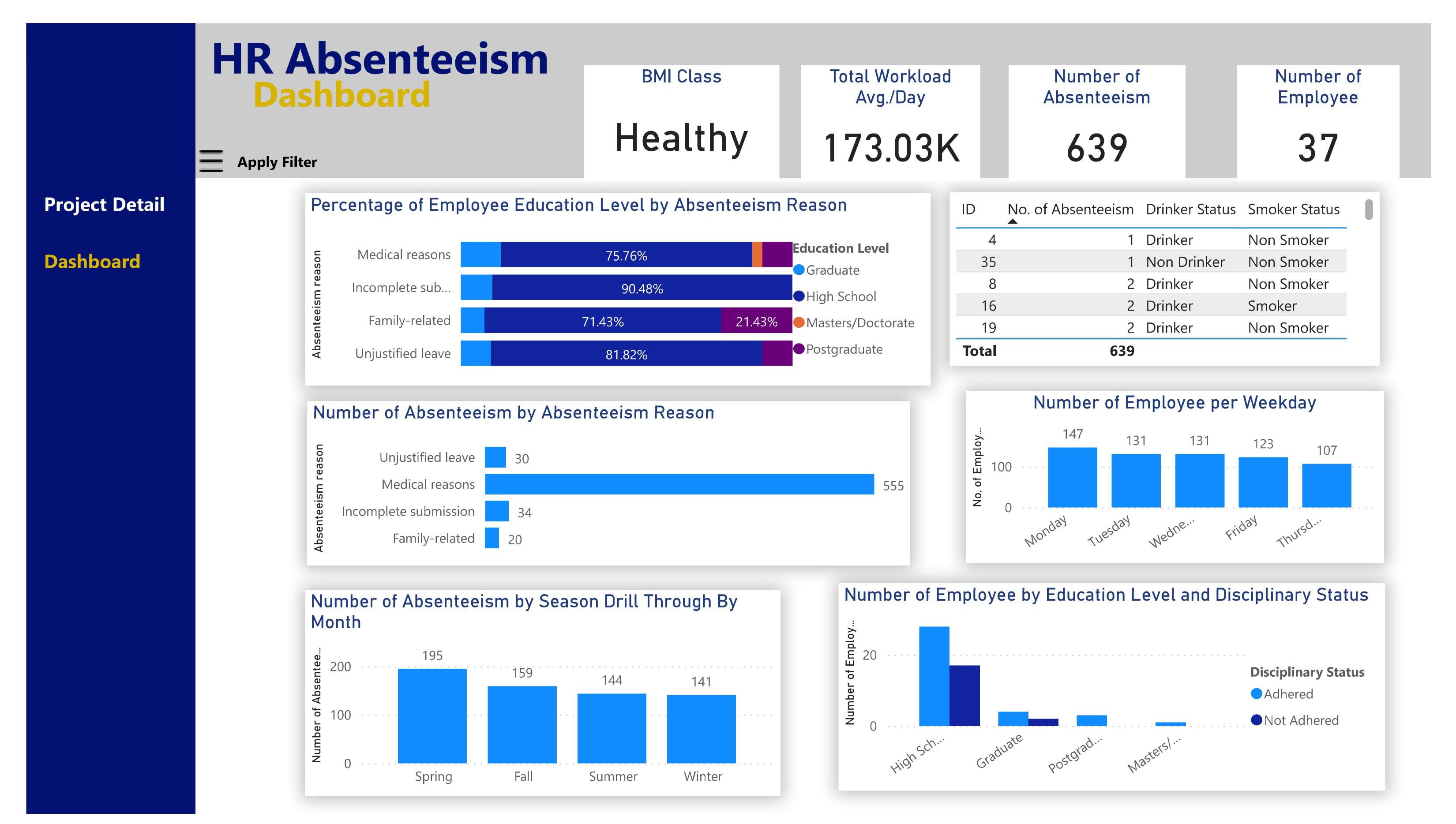
The dashboard has two views — a project overview and a detailed analytics view — with a navigation bar to move between them. Filters are hidden by default and revealed on demand, keeping the interface clean without sacrificing depth.
My Contribution
Data Pipeline & Quality
The data came from two sources: a SQL database and a CSV file. I merged and loaded them into Power BI, then ran a thorough data quality pass — resolving missing values, removing duplicates, and addressing outliers that would have skewed the analysis.
Feature Engineering with DAX
Raw HR data rarely contains the variables that matter most for absenteeism analysis. I used DAX to engineer the custom fields that made the patterns visible:
- BMI — derived from height and weight fields, used to identify overweight and obese employees
- Month and Season — extracted from absence dates to surface time-based patterns
- Absence frequency buckets — to distinguish chronic absentees from occasional ones
These weren’t cosmetic additions. Without BMI, the lifestyle-health connection in the data would have been invisible. Without seasonality, the management would have had no basis for anticipating peak absence periods.
Exploratory Analysis
I ran the analysis from multiple angles — by reason for absence, by employee profile, by time of week, and by lifestyle characteristics — to build a complete picture rather than a single headline number. The goal was to give management not just what was happening, but who it was happening with and why.
What the Data Revealed
The findings were specific enough to act on — which is the point.
Medical reasons dominate, and lifestyle is the driver
Of 639 recorded absences, 87% (555 cases) were attributed to medical reasons. That sounds like a health problem — but the data told a more specific story.
Of those 555 medical absences, 12 overweight or obese employees accounted for 272 (49%) of them. Nearly half of all medical absences traced back to less than a third of the employees flagged for medical reasons.
Those same 12 employees were disproportionately smokers, drinkers, or both. And a striking pattern emerged in the timing: Monday was their most common day of absence — suggesting that weekend social behaviour was contributing directly to weekly absenteeism.
Disciplinary gaps are being exploited
The second most common reason (34 cases from 21 employees) was incomplete task submission. Of those 21 employees, 19 had previously received disciplinary action that they did not respond to — a clear sign that existing disciplinary processes lacked sufficient consequence.
A similar signal appeared in the family-related absence category: 11 of the 20 employees who cited family reasons had neither a child nor a pet, raising questions about whether those absences were genuinely family-related or a softer justification being used under weak enforcement.
Additionally, 11 employees were absent 30 times with no documented reason at all — something that should not be possible under a functioning attendance management process.
Recommendations to Management
Each recommendation is tied directly to a finding in the data:
1. Strengthen disciplinary processes The pattern of repeat absences with no documented reason, combined with disciplinary actions that employees ignored, points to a process that doesn’t carry enough weight. Formalising consequences and consistent follow-through would address more than 20% of total absences based on the data.
2. Launch a targeted health and wellness programme The concentration of medical absences among employees with high BMI suggests that a structured health initiative — access to fitness facilities, nutritional guidance, regular health screenings — could reduce medical-related absences by an estimated 30% or more.
3. Provide smoking and alcohol support Several of the highest-absence employees are active smokers or drinkers. Framing this as support rather than punishment — cessation programmes, anonymous counselling, healthcare coverage for treatment — is more likely to achieve genuine behaviour change than policy enforcement alone.
4. Recognise consistent attendance Addressing the people who are absent frequently is only half the equation. Recognising and rewarding employees who show up consistently and perform well reinforces the culture the company wants to build — not just the behaviour it wants to discourage.
Tech Stack
| Area | Tools |
|---|---|
| Analytics & Dashboard | Power BI |
| Custom Calculations | DAX |
| Data Sources | SQL Database, CSV |
| Project Management | Trello |
What I’d Do Differently
- Predictive modelling — the current analysis is descriptive: it tells you what has already happened. A logistic regression or decision tree model trained on employee profiles could predict which employees are at elevated risk of becoming chronic absentees before the pattern is established, giving HR an earlier window to intervene.
- Sentiment or survey integration — absenteeism data tells you when and how often, but rarely captures employee experience directly. Pairing this analysis with anonymised engagement survey data would surface whether job satisfaction, management quality, or workload are contributing factors the HR data can’t see.
- Longitudinal tracking — a one-time analysis captures a snapshot. A dashboard that automatically updates as new absence records come in, and flags when any employee’s absence frequency crosses a defined threshold, would turn this from a report into an ongoing monitoring tool.
- Anonymisation controls — with data this granular, the risk of identifying specific individuals is real. A production version of this dashboard would need role-based access controls to ensure that sensitive employee-level data is only visible to people with legitimate HR authority.
Team
This project was a collaboration. Credit to:
- Oluwaseyi Rachael
- Osayande Emmanuel
- Emmanuel Greensmill
Let’s Talk
If you’re working on an HR analytics, business intelligence, or data-driven decision-making problem — get in touch.